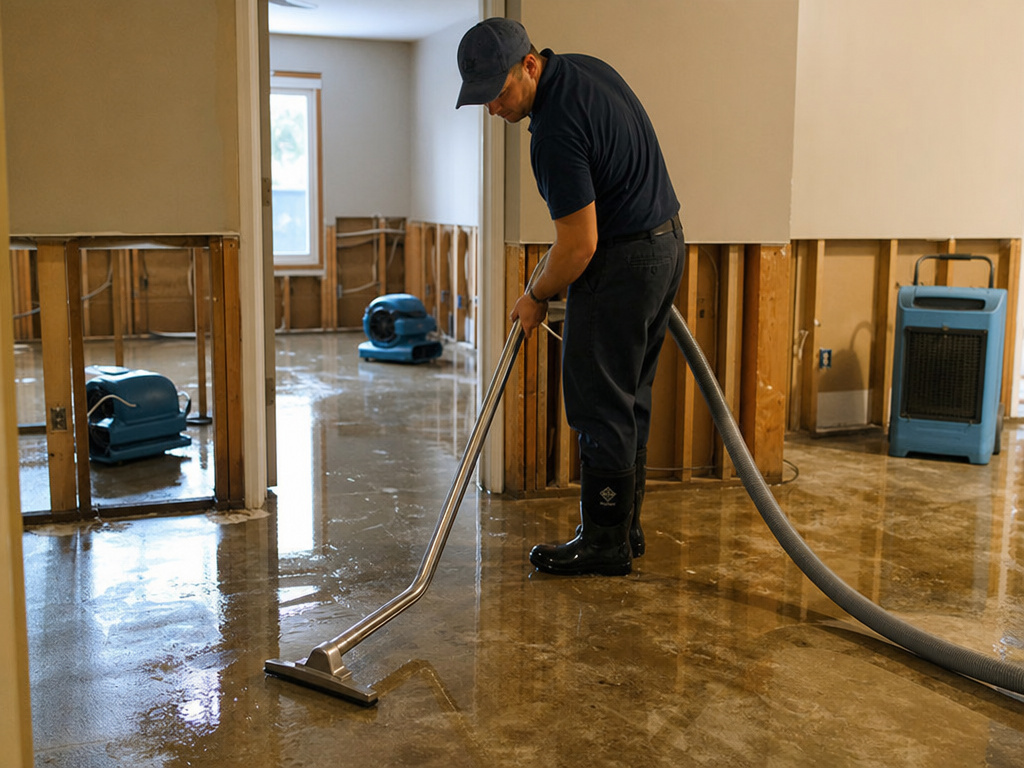
In Johnson County homes, flood damage often starts with sump pump failures during spring storms or supply lines that freeze during winter cold snaps. Finished basements in Corbin Park and Prairie Village hold water against drywall and flooring, while slab foundations in Metcalf 108 and Downtown Overland Park allow moisture to wick upward from below.
Water is classified on site as Category 1 clean, Category 2 gray, or Category 3 black. After the first 24 to 48 hours untreated, mold growth accelerates and porous materials must be removed. Moisture mapping with meters identifies hidden saturation behind walls and under subfloors before any drying equipment is placed.
Extraction removes bulk water first, followed by placement of air movers and dehumidifiers sized to the affected square footage. Technicians decide on site whether drywall can be saved by cutting flood cuts or whether carpet pad and hardwood must be discarded. Monitoring visits track moisture levels daily until readings return to normal.
Documentation for claims includes time-stamped photos, moisture logs, and an itemized scope of work that lists every step performed. This record is prepared at the 6800 W 115th St address and delivered to the homeowner before the final walkthrough.
Flood Damage Restoration Services We Offer
✓Basement Flood Extraction
Removes standing water from finished basements common in Corbin Park and Prairie Village before mold sets in after 24 hours.
✓Category 3 Black Water Cleanup
Handles contaminated water from sewage backups or heavy spring runoff that reaches homes near Corporate Woods and the Overland Park Arboretum.
✓Slab Foundation Drying
Uses targeted moisture mapping and drying mats to pull water from beneath concrete slabs in Downtown Overland Park and Metcalf 108 properties.
✓Sump Pump Failure Drying
Restores homes after power loss or mechanical failure during Johnson County storms, including structural drying of lower levels.
✓Winter Freeze Line Restoration
Addresses burst supply lines that occur during cold snaps, with extraction and drying focused on affected walls and floors.
✓Moisture Mapping and Monitoring
Tracks hidden moisture behind drywall and under flooring with daily meter readings until levels stabilize.
Flood Damage Restoration Cost in Overland Park, KS
| Service | Typical Range | What Affects It |
|---|---|---|
| On-site assessment and moisture mapping | Free | Includes water category classification and written scope for insurance. |
| Category 1 or 2 extraction and drying | $800–$2,200 | Varies with square footage and number of days equipment remains on site. |
| Category 3 black water cleanup | $1,500–$4,000 | Higher due to containment, PPE, and disposal requirements. |
| Daily monitoring visits | $150–$250 per visit | Includes meter readings and equipment adjustments until dry. |
| Salvageable drywall flood cuts | $300–$700 | Depends on linear feet and number of walls affected. |
Ranges are typical for Overland Park, KS and confirmed with an exact written quote before any work starts.
How it works
- 1
Initial Assessment
Technician arrives, identifies water category and class, maps moisture, and explains what materials can be saved versus removed.
- 2
Water Extraction
High-volume pumps and wands remove standing water from basements and slabs before drying equipment is staged.
- 3
Drying And Dehumidification
Air movers and dehumidifiers are positioned for maximum airflow; daily visits confirm progress until dry standards are met.
- 4
Documentation And Handover
Photos, logs, and scope are compiled for the insurance claim; final walkthrough confirms the home meets pre-loss moisture levels.
Pricing
Cost is driven by water category, affected square footage, and whether materials must be removed. Insurance often covers sudden water damage minus the deductible. Free on-site assessment is provided during listed business hours.